
Key takeaways from MAD//North 2026
Summary:
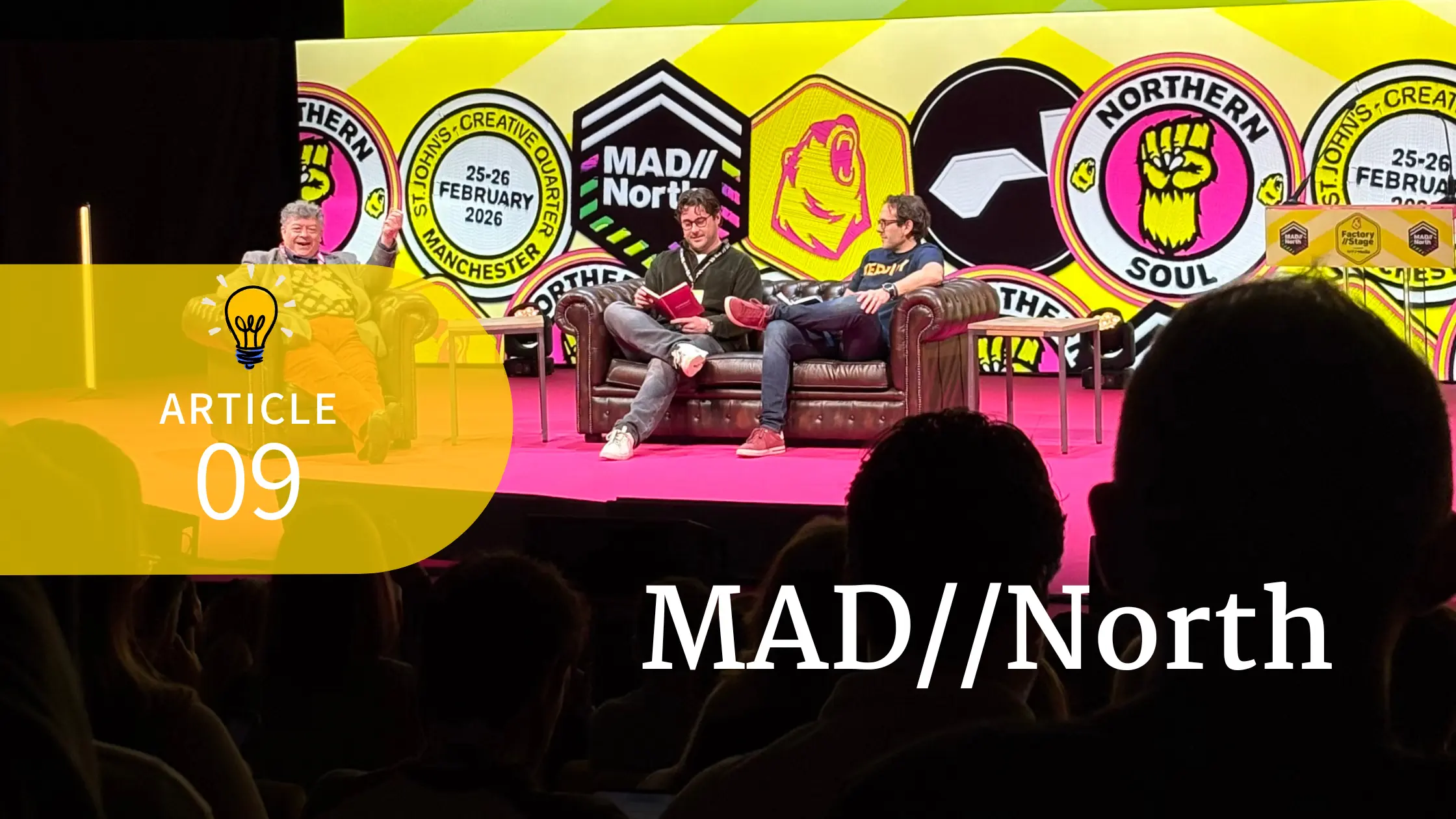
We spend most of our time caught up in tasks. Emails. Meetings. Deadlines. The everyday rhythm of keeping campaigns running and stakeholders happy. It’s easy to forget to look outside, to see what’s changing, what’s working elsewhere, what we should be questioning. That’s why I went to MAD//North in Manchester. Two days of talks on marketing, social, behavioural science, leadership, media, and more. Here’s what I learned.
The useful stuff: Data, trends, and insights
Brand loyalty doesn’t exist.
Let’s start with this: shoppers don’t belong to us. We win moments, not customers. History isn’t a contract. Research from Trinity McQueen showed that 68% of people shop without a list. They have a mission or problem to solve, but decisions aren’t locked in. Only 1 in 5 had a brand name written down. We’re chosen when we show up mentally and culturally, not because they bought from us before.
The implication: brand building is essential early in the shopper journey (build familiarity and trust before they buy), but we also need to show up late (at the point of purchase, when decisions actually happen). The store is a prompt. First exposure matters. Shoppers are flexible, they’re in a rush, and they don’t want to leave empty-handed. We need to be there – before, during and after.
Buying is irrational and social.
We rationalise purchases, but that’s not how it works. People are loyal to their communities, not brands. Influence travels locally first. Rory Sutherland reminded us: marketers underestimate the power of social influence. We buy through reinforcement. We buy what our network buys.
The implication: if we only look at customer acquisition cost (CAC), we miss the community behind every customer. Not everyone has to be local, but local needs to be strong. People are part of communities and have influence. Start there, build strong, then scale (Tom Ridges).
We trust people like us, not institutions.
We trust friends, community, people like us. Not institutions. Kate Nightingale (Humanising Brands) explained that brands need to align with us on three levels: short-term (everyday rituals), mid-term (cultural trends and economic changes), and long-term (our values and identity). In 15 milliseconds, we decide if we trust a brand. Psychology codes can help us get there.
People view brands like human beings (neuroscience evidence supports this). We expect brands to be like us: more human. The more sensory representation a product has, the higher the engagement, attention, and conversion. Brands that don’t use our senses (we have 53 of them – did I get this right? – not just five) break up with us. There’s no reality, only perception.
The Big 4 control 79% of ad spend and attention.
Meta, Amazon, Google, TikTok. They control 79% of ad spend = 79% of attention. They’re undervalued, and they’ll get bigger. From awareness to consideration, they’re the first to know. From upper funnel to mid-funnel, they dominate.
How do we become “mid-funnel monsters”? Data + creative. Find the right audience at the right time to turn consideration into action at scale. Google’s quality score, Meta’s relevance score, TikTok’s engagement metrics: they all reward relevant, responsive ads no matter what brand you are. More creative = more performance. Prioritise the Big 4. Tap consideration and turn it into retention. Win with culture, creative, content.
Cross-channel doesn’t mean more channels.
It means better use of channels. Connect them. Define clear KPIs and align them across platforms. Create an omnichannel model. Test, then scale. Don’t wait for perfect conditions. We learn by doing. Multi-channel should not mean multi-chaos. Be strategic.
AI is affecting creative, workflow, data management, and campaigns. AI accelerates, it doesn’t replace. The gap between brands that adopt AI and those that refuse will widen over the next 12-18 months.
Community over reach.
Retail media isn’t about screens anymore. It’s about relevance (I know, this sounds like AI but it’s what they said). People want brands that show up in their communities; familiar, trusted, local. Discovery happens through multiple exposures. Most of our influence is local. Develop a community engagement plan. Today is about chasing relevance and community, not reach.
Serendipity is replacing search.
People open TikTok looking for something specific and discover brands they didn’t know existed. Behind every viral product are hundreds of tests. Experiment constantly. TikTok is now a search engine with billions of daily searches. Content that feels familiar and authentic gets rewarded: ads, UGC, specific keywords.
Trends to watch: Reali-TEA (people want to see the process behind brands), Curiosity Detour (you start looking for one thing and discover something else), and Emotional ROI. Look into trends and community to go viral. Collaborate with creators early. Involve them in strategy. Long-term collaborations work better. Sometimes it takes time for content to perform. One key message per content (max two). Don’t force brand integration in the first few seconds.
Linear isn’t dying.
Streaming will grow, but there’s still a need for both short snackable content and long-form. Young audiences want the same stories as older audiences; just told differently: fast-paced, accessible. The role of linear TV is still strong. BBC invests heavily in the UK economy (99% of commissions are UK-based). ITV is following the audience, not driving behaviour. Sky is investing in content and cultural moments. Everything will eventually be delivered through multiple surfaces: on demand, linear, digital. (Channel 4)
Creativity comes from necessity, not privilege.
When you have nothing, you have nothing to lose. You can’t buy soul, but you can export it. Not giving a f*** is empowering. Creativity comes from necessity. Don’t lose that chip. Embrace it.
The Less Boring stuff: What to action now
… if you want to do something with all of this.
Stop assuming loyalty exists. Show up early in the buyer journey (build familiarity and trust) and show up late (at the point of purchase). Don’t assume past behaviour predicts future purchases. Build association with the mission or need your product solves. Make it convenient. People don’t want to leave empty-handed.
Think local first. Influence through communities. Start local, build strong, then scale. Don’t spread yourself thin trying to reach everyone. Concentrate your activity where you can build real connections. People buy what their network buys.
Align with how people actually live. Short-term: everyday rituals. Mid-term: cultural trends and economic shifts. Long-term: values and identity. Meet people where they are. Use multiple senses, not just visual. The more sensory representation, the higher the engagement.
Prioritise the Big 4. Meta, Amazon, Google, TikTok. That’s where attention is. Use data + creative to turn consideration into action. More creative = more performance. Quality scores reward relevance.
Connect your channels. Not more platforms, better use of platforms. Define clear KPIs. Align them. Test, then scale. Don’t wait for perfect conditions. Learn by doing.
Build community, not reach. Be familiar, trusted, local. Show up in places that matter to your audience. Develop a community engagement plan. Retail media is about relevance, not screens.
Experiment constantly. Behind every viral product are hundreds of tests. On TikTok especially. Work with creators early, give them one clear message, let them integrate the brand naturally (not in the first few seconds). Long-term collaborations work better than one-off activations.
Use AI to accelerate, not replace. The gap is widening between brands that adopt AI and those that don’t. AI should speed up your workflow, creative process, data management, and campaigns. It doesn’t replace human judgement, it makes you faster.
Tell stories, don’t sell. Humour drives memorability, but relatable stories work better than pure emotion. Great stories need participation, escapism, and connection. Stop selling. Start storytelling.
Lead with connection, not command. Old leadership was about control. New leadership is empathy, intuition, collaboration; the skills AI can’t replace. Leadership isn’t one-size-fits-all. Everyone flexes in style. Evolve your language. Remove bias. Stay curious. (Pardeep Duggal)
What we’ve learned
After two days at MAD//North:
Not every brand understands how to integrate behavioural science into their marketing strategy. Most brands talk about understanding their audience, but few build content that aligns with how people make decisions (irrationally, socially, based on what their community does). There’s a gap between knowing the theory and applying it.
Command and control leadership is old and gone. I’m happy that empathy, intuition, and collaboration are being named as the new leadership skills. This should be a lesson for many “leaders” still operating like it’s 2005. The future of work requires leaders who listen, adapt, and bring people along, not dictate from the top.
Stepping away from our desks is always refreshing. We get trapped in corporate dynamics, deadlines, and the belief that we’re too busy, or too right, to look outside. But the best ideas come when we stop and learn from people doing things differently.
Our projects matter, even with smaller budgets. I saw a brand celebrate reaching thousands of people organically. With my team, we reach millions and I never talk about it because I compare myself to big names. But f*** it. Life begins at f*** it (Thanks Vicki Maguire for saying that!). Wherever you are in your journey – big brand, small team, tight budget – share what you do. Your work is valuable.